Spec Battle: Anker 20 000Mah 87W Power Bank vs Iniu P51L E1 Power Bank — Is It Worth Upgrading?
Power banks are no longer simple battery packs for topping up a phone—many aim to replace small chargers, keep laptops running on the go, or support multiple devices at once. Two common choices that often come up when shoppers consider an upgrade are the Anker 20,000mAh 87W power bank and the INIU P51L E1 (20,000mAh) power bank. They share the same headline capacity but target different priorities: raw output and laptop-class charging on the Anker, and compactness, built-in cabling and everyday convenience on the INIU. This article compares both in depth, explains real-world use cases, lists pros and cons, and offers a buying guide so readers can decide whether upgrading makes sense for their needs.
Quick overview
Anker 20,000mAh 87W Power Bank — positioned toward users who need high sustained USB-C Power Delivery. It is built to support charging of power-hungry laptops, tablets and multiple devices simultaneously with a total system output that can reach around 87 watts (depending on port combination and model-specific limits).
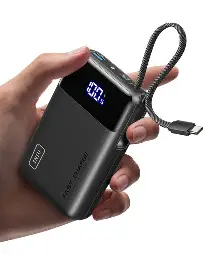
INIU P51L E1 (20,000mAh) — focused on compact portability and convenience features. The E1 variant typically provides more modest fast-charging output compared with higher-wattage INIU variants; it emphasizes a smaller footprint, one-touch usability, built-in cable options and simple daily carry rather than replacing a laptop charger.
Detailed product analysis
Anker 20,000mAh 87W Power Bank — what it brings to the table
The headline for this Anker unit is the 87W maximum output. For users who frequently need to top up laptops (thin MacBook-style laptops, higher-end Ultrabooks, some Windows laptops that accept USB-C PD) or want to fast-charge a phone while also running a tablet, the higher wattage matters. Typical characteristics of this class of Anker power bank include:

- Capacity: 20,000mAh (nominal). This provides multiple phone charges and several hours of laptop boost depending on device efficiency.
- Max output: Up to ~87W total across its USB-C ports (single-port peak depends on model); useful for many 13–14" laptops and for fast phone charging.
- Ports: Usually two USB-C PD ports and at least one USB-A for legacy devices. Port distribution enables charging more than one device at full speed in many scenarios.
- Fast-charge support: USB-PD (Power Delivery), often PD 3.0 and compatibility with PPS/QC for optimized phone charging.
- Design: Larger and heavier than compact 20,000mAh packs—this is the tradeoff for higher-power cell chemistry and circuitry.
Real-world performance: this Anker shines when a laptop needs power away from mains. For example, on a long flight or workday away from a desk, the Anker can extend a MacBook Air or many USB-C laptops by a few hours, and still refill a phone to 50–80% rapidly. When powering several devices, total output is shared between ports, so two devices at once may not each get the full 87W; yet even split, the available power typically exceeds typical phone/tablet draw and remains useful.
INIU P51L E1 — focused portability and everyday convenience
The INIU P51L family has several sub-variants; the E1 model is the more travel- and phone-focused option. It trades extreme peak wattage for compactness, integrated convenience and a user-friendly feature set. Key characteristics include:
Discover deals on Mobile Phones — updated daily.
View Offers →- Capacity: 20,000mAh (nominal).
- Max output: The E1 variant is designed around everyday fast charging and commonly supports output levels in the lower PD range (the P51L lineup includes higher-watt options, but the E1 specifically targets phone/tablet charging power rather than laptop-class output).
- Ports and built-in cable: Some INIU packs in the P51L series include a built-in cable (USB-C or Lightning depending on SKU) plus USB-C and USB-A ports—this reduces the need to carry extra cables for many users.
- Form factor and weight: Noticeably smaller and lighter than high-wattage portable chargers, making it easier to carry in a backpack pocket or travel bag.
- Extras: Digital battery level display, simple flashlight or LED indicator, and soft-touch finishes on many models.
Real-world performance: the P51L E1 is excellent as an everyday carry option. It comfortably recharges modern phones multiple times, fills tablets reasonably fast, and is small enough to toss in a day bag without adding significant bulk. It’s ideal for commuters, day travelers, and users who value built-in cables and convenience over the ability to charge a full-size laptop for hours.
Head-to-head comparison
| Specification | Anker 20,000mAh 87W | INIU P51L E1 (20,000mAh) |
|---|---|---|
| Typical capacity | 20,000mAh (nominal) | 20,000mAh (nominal) |
| Maximum output (peak) | ~87W total (USB-C PD; single-port peak varies by model) | Lower PD range (E1 tuned for phones/tablets; other P51L variants go higher) |
| Ports | Typically 2× USB-C (PD) + 1× USB-A (varies by SKU) | USB-C, USB-A and sometimes a built-in cable (model-dependent) |
| Fast-charge protocols | USB-PD (PD 3.0), PPS, QC compatibility | USB-PD (E1 lower PD level), QC, PPS on compatible models |
| Weight & size | Heavier / larger (built for power delivery—expected noticeable heft) | More compact and lighter (designed for portability) |
| Best for | Users who need laptop-class USB-C PD and multi-device fast charging | Everyday carry, commuters, travelers who want built-in cables and light weight |
| Extra features | High-output PD, robust power management, likely LCD/LED status | Built-in cable, digital display, flashlight, soft-touch finish, warranty |
Pros & Cons
Anker 20,000mAh 87W Power Bank
- Pros:
- Very high maximum output for a 20,000mAh unit—can meaningfully extend many laptops and charge tablets/phones quickly.
- Multiple USB-C PD ports let users charge more than one device at useful speeds.
- Robust power-management and protocol support (PD, PPS, QC) for broad compatibility.
- Cons:
- Size and weight are noticeably larger than compact 20,000mAh banks—less convenient for minimal carry.
- Higher-capability hardware usually costs more than budget 20,000mAh options.
- When charging multiple devices simultaneously, per-port wattage may fall short of single-port peak.
INIU P51L E1 Power Bank
- Pros:
- Compact, lightweight design makes it an easy everyday carry.
- Built-in cable options reduce the number of accessories to bring along.
- Digital display and user-friendly features make charge state easy to read.
- Lower-cost than some high-wattage alternatives while still providing solid phone/tablet charging.
- Cons:
- Not designed to replace a laptop charger—E1’s peak output is limited compared with 87W units.
- Users who need sustained laptop charging will find the E1 insufficient for full-session power.
- Multiple simultaneous heavy draws will reduce per-port charging speeds significantly.
Performance in real-world use cases
1. Commuters and day-trippers
For commuters who carry a single phone and maybe a pair of wireless earbuds, the INIU P51L E1 is often the more sensible choice: it’s lighter, easier to tuck into a bag pocket, and built-in cables reduce cable clutter. A full day of active smartphone usage (heavy email, maps, streaming) is commonly covered by a single full charge or two from this pack.
2. Remote workers and laptop users
Those who leave the office with a laptop and need to work for several hours away from mains will appreciate the Anker 87W option. The Anker is better suited to giving a significant battery boost to a USB-C laptop, turning a drained 8–10% laptop into a machine that can run for multiple additional hours, or keep a device working through a short commute or flight.
3. Family or multi-device households
If charging multiple phones, a tablet, and accessories simultaneously is a common scenario, the Anker’s higher aggregate output provides more headroom. The INIU can still manage this load but will split available power more conservatively, which lengthens charge time for each device.
4. Travel and airline considerations
Both are nominally 20,000mAh and thus usually fall under the airline-friendly threshold for lithium batteries (airlines typically permit power banks up to 100 Wh; 20,000mAh at 3.7V ≈ 74 Wh). Travelers should still verify airline policy and local regulations. The INIU’s lighter weight is a minor advantage for long trips where every ounce matters.
Discover deals on Mobile Phones — updated daily.
Shop Amazon →Buying guide — how to decide whether to upgrade
Choosing between a high-output 87W pack and a compact convenience-focused unit comes down to a few practical questions. Consider these decision points:
- Do you need to charge a laptop regularly? If yes, prioritize high PD wattage (like the Anker). If not, lower-wattage compact units are more efficient for phones and tablets.
- How important is portability? If the power bank spends most of its time in a day bag or pocket, a lighter pack with built-in cables (INIU-style) is more pleasant to carry.
- Do you carry multiple devices at once? For households or multi-device users, total output and number of PD ports matter more than absolute capacity alone.
- Is fast recharge of the power bank itself important? Check the input wattage. Higher input (e.g., 18–27W or more) means the bank refuels quicker when back at a charger.
- Which charging protocols are required? Ensure the bank supports USB-PD, PPS or Quick Charge for the devices in use. Some phones gain much faster charging when the right protocol is present.
- Air travel and regulations: Confirm the Wh (watt-hour) rating if traveling by air; 20,000mAh nominal capacity commonly sits below the 100 Wh limit that most airlines follow.
- Warranty and reliability: Brands differ in warranty length and support. Consider reputation for safety features and long-term reliability.
Practical tips for using a 20,000mAh power bank well
- Rotate charging: If the bank supports multiple inputs, use a higher-wattage USB-C PD charger to refill it quickly between trips.
- Manage simultaneous loads: To get fastest single-device charging, plug only that device in; shared charging reduces per-port wattage.
- Keep firmware and cables in good condition: Use good-quality cables that support PD/PPS to achieve rated speeds.
- Follow airline rules: Store the power bank in carry-on luggage, not checked baggage, and carry documentation if asked for Wh rating.
Who should upgrade?
Consider the following short guidance for readers deciding whether an upgrade is worth it:
- Keep the Anker (or upgrade to a high-wattage pack) if: the priority is charging a laptop on the go, supporting several power-hungry devices, or reducing time spent tethered to wall outlets. The extra weight is an acceptable tradeoff for laptop-class PD and multi-device usefulness.
- Stick with or choose the INIU P51L E1 if: portability, built-in cable convenience, and light daily charging tasks dominate—commuting, day trips, and minimalist carry. It’s also generally cheaper and less bulky for day-to-day use.
Conclusion
The decision to upgrade depends on what “worth it” means for the buyer. If replacing a small phone-only battery with something that can meaningfully power a laptop or multiple high-draw devices was the goal, the Anker 20,000mAh 87W power bank is a logical step up: it delivers laptop-capable USB-C PD and greater flexibility for power-hungry workflows. If the goal is a lighter, more convenient everyday companion that reduces cable clutter and remains comfortable to carry, the INIU P51L E1 remains a sensible choice.
Both options deliver the core promise of a 20,000mAh pack—multiple charges for modern phones—but they answer different questions. The Anker answers “Can I unplug and still work?” while the INIU answers “Can I carry less and stay topped up?” Evaluating daily device habits, travel patterns and whether laptop charging is routinely necessary will make the answer clear: upgrade to the Anker for power and flexibility, or choose the INIU for portability and simplicity.